Saturday, 9 April 2016

Engaged and Excited-Geometry Art


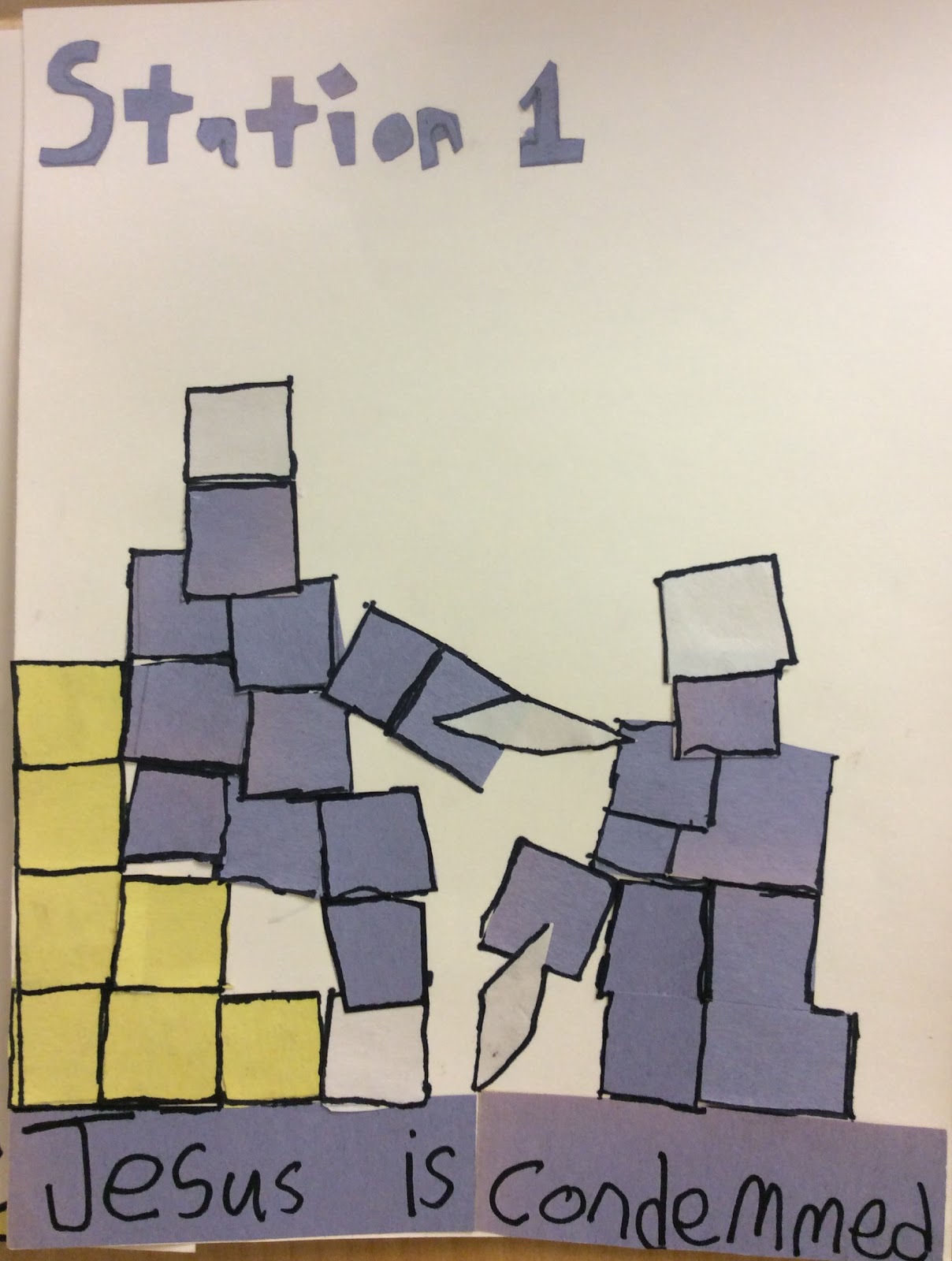
In this activity, students used polygons to recreate one of the stations of the cross. The student was responsible for researching all of the stations and then creating an art piece to depict what one of them was about. 

I found that the students were engaged and excited to guess which station other students were doing. 

In the future I would have the students create all of the stations in order as a graphic text. They could also write from different perspectives for the witnesses and for Jesus for a station of the cross. 


Thanks to Ridgetown teacher, Janice Knowler @MrsKnowler for sharing!


Changing My Approach-Exciting and Rewarding

Changing educational approaches to something as tried and true as the classroom novel can be a daunting and potentially frightening task. However, coming to the end of a novel unit that turned my usual practice on its head, I can honestly say that changing an approach is exciting and rewarding. 


I used a student-voice centered, inquiry based, collaborative approach to teach the novel To Kill a Mockingbird to grade 10 academic English classes. The students were very excited to discuss the aspects of the novel that excited and intrigued them. 


“(Before this experience I would have said that,) I usually just like to read a book - I don’t like classroom novels because all the questions make it boring and less exciting to read.

(This time,) getting to really think about To Kill a Mockingbird and discuss what I found interesting and shocking and exciting was really cool. I really enjoyed studying this way and I feel like I understand everything well. “ - Grade 10 Academic Student


Learning was exciting and the classroom environment was organic. Small group, large group, student blogs and google classroom were some of the learning environments and partnerships used. 


Despite my reservations, I was able to cover all pertinent curriculum and did so in a way that was more rewording and meaningful for the students and myself. 

Inquiry learning in the high school English classroom is definitely worth the time. 


Thank you to guest blogger, SCCDSB Secondary English teacher from Sarnia, ON, Natalie Gouveia, who can be found on twitter @thebard18


Tuesday, 5 April 2016

What Can They Can DO Rather than Know... One Teacher’s Thinking on Inquiry - Part Three

This is part three of a three part post - 2 STEPS TO SIMPLIFIED INQUIRY: Research & Thinking.  Thanks for reading!

A colleague asked for some help in putting together an inquiry, so I put this together as one idea..

A simple machine unit that culminates in building a Rube Goldberg machine and documenting the attempts and successes.


Thanks to a SCCDSB teacher from St Michael's in Ridgetown who submitted this post. She has chosen to have her name withheld.

Monday, 4 April 2016

What Can They DO Rather than Know..One Teacher’s Thinking on Inquiry. - Part Two

This is the second in a three part post: 2 STEPS TO SIMPLIFIED INQUIRY: Research & Thinking   

Step 2:  THINKING ---Thinking Critically!!
  • Students click on a link -now what?
I will be honest - this part is even trickier.  Students new to inquiry and research will expect that the answer will be sitting there in huge bold print!  They feel frustrated when they discover that it never is.  This is where we train our kids to scan passages for keywords or numbers and to read around the text.  This is the evaluate portion of inquiry.  They will need to keep verifying what they think is the correct information against the actual question.  Was this the information I was asked to collect?  Does this answer the question posed?  Your kids will get better at this with lots of exposure, but in my experience they start with some pretty impulsive behaviours and don't really want to read accurately on their own.  They are happy to sit back and wait for you to do it for them.  Don't!  If they don't find exactly what they need from one site, have them persevere and try another.  In the process they will come across and gather more information than just your initial specific expectation.  Therefore, increasing their background knowledge.  Your students will be reading and thinking- killing two birds with one stone.
  • They find facts and data.  So What!
This is where you want to prompt them to discover the significance behind these facts and listen to what connections they can make from their own schemas. This is also where you can focus on student interest and try to build some side research if they seem intrigued by something.
e.g.  FACT:  Early Settlers traveled for many weeks across the Atlantic under some terrible conditions.
TEACHER PROVOCATION:  “So what?  What can this tell us?”
STUDENT EXAMPLES:
  • “I know that the boat ride was a horrible experience” - so why did they come?
  • “I know that they would have landed and stepped into wilderness and scary conditions” - again, so why would they even want to come?
  • “So I think they must have had some very serious reasons for coming to Canada in the first place.  Let me find out what these reasons were.”  (Religious persecution; famine; poverty etc.)

THINK OUT LOUD - LEVERAGE DIGITAL:
IMG_3507.PNG
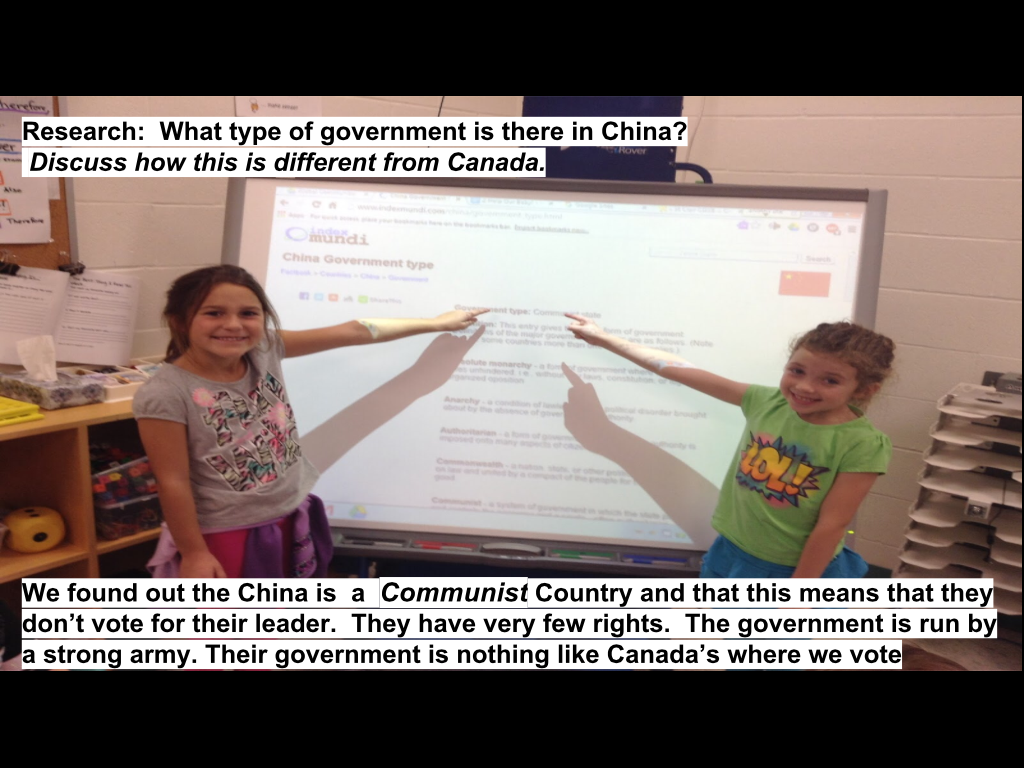
These students used Chromecast to project what they found about global forms of government and then came up to discuss what they think their information meant.  They also listened to what their peers thought.
Try a variety of digital tools to get the students “thinking out loud” and considering the opinions and perspectives of their classmates.  Tools such as Chromecast as well as self documenting tools like Educreations, Explain Everything, and YouTube Capture, are also fun ways to get students to vocalize and share their thoughts.


The point is, there isn't any specific formula for making inquiry work.  Every day is a balancing act.  We want to cover the curriculum but in a way that gets our students thinking, developing those metacognitive skills, and coming to a deeper understanding of the concepts. 

This might be possible with good inquiry, if we focus on just two main ideas: research and thinking.  Then, when it's time to do reporting, our comments can focus more on what our students are able to do rather than what concrete information they know.   

Watch for part 3 soon!


Thanks to an SCCDSB teacher from St Michael's in Ridgetown who submitted this post. She has chosen to have her name withheld.

Wednesday, 2 March 2016

What Can They Can DO Rather than Know... One Teacher’s Thinking on Inquiry - Part One

2 STEPS TO SIMPLIFIED INQUIRY: Research & Thinking. This is part one of a three part post - watch for part two soon!


When we think of incorporating inquiry into our classroom we really don't have to stress and find new ways to think outside the box and stray from the curriculum.  Rather stick with the curriculum as your guide as you always would, but be less concerned with covering all the content and focus more on skill development.


We are teaching in some pretty amazing times.  Our students really have no great need to remember copious facts about layers of soil or which provinces didn't initially agree with confederation.  With a swipe of their fingers they can find the answer in 5 seconds or less on the very same device that they seem glued to or that is never very far away.  With inquiry we have the potential to expand critical literacy skills to amazing heights if we just keep the focus on a few main steps.


2 STEPS TO SIMPLIFIED INQUIRY: Research & Thinking


Step 1: RESEARCH -- Have Them Gather Their Own Information
Aidan Finds India
This student locates countries on different online maps independently and thinks about what life might be like there based on location.
Start with the general or even specific curriculum expectation (the reality is, as a teacher, you can't really afford to wait and see what they are truly interested in because chances are they have never given much thought to our curriculum topics to begin with and let's face it, you’re on a timeline! Switch your thinking and consider that your job is more to expose them to the topics and then see what they think!) 
However, instead of passing out specific handouts, have the students collect as much information as they can, leveraging whatever digital tools you have available in the classroom.  This is the gather portion of inquiry.  This does mean that you have to teach them and provide prompts for how they can best word their searches and how to scan the text link descriptions with a critical eye so they become efficient at choosing the most profitable site.  This takes time and training!


Tip:  You might want to post the expectation as a learning goal like this example:
“We are going to learn how to find information about …...by using best strategies for finding accurate information on Google Search.”

Part two: Thinking - coming soon.


Thanks to an SCCDSB teacher from St Michael's in Ridgetown who submitted this post. She has chosen to have her name withheld.

Tuesday, 24 November 2015

Just Start... Dump the Whole Class Novel Study. A Risk Worth Taking


Since creating my first blog post several weeks ago, I've been reflecting on how to use Robin Sharma's message to just start in my classroom.  I've been contemplating whether or not to dump a traditional whole-class novel study in my English class and explore 'Book Clubs' as an alternative.  This seems like an incredibly uncomfortable risk when we are bound by the time constraints of a semester and we grimace at the potential lack of control this process proposes.
Our curiosities about tragedy
.
I am blessed with a group of open-minded students who have joined me on a renewed teaching journey this year... 

So I've scrapped all my old materials and changed up my teaching style dramatically with this class to allow room for greater risk-taking. It's a messy venture at times, though the results are promising.

Many of my students entered my classroom with self-deprecating thoughts and beliefs, especially about their academic abilities. 

I have seen every single one of my students shine in some way or another this term - reluctant readers have found books to love, anxious nerves have been overcome to complete oral presentations, shy thinkers have openly shared their beliefs during class and struggling writers have found their voice through greater organization and development. 

We started the unit by examining two key inquiry questions - What is love? (cue video:  Haddaway) and What is tragedy? 

I'm inspired by the variety of beliefs and experiences that these students were able to share on these topics. Love and tragedy seem to be so central to teen experience (and really, aren't they central to experience regardless of age?).

Because of these successes, we are entering the realm of book clubs. Our focus is 'tragic love' and as such we've chosen four high interest texts to examine this concept, including a graphic, plain-text novelization of 'Romeo and Juliet'!

.
Our curiosities about love.  Hmmm... interesting.
At any rate - we have started - and I am nervous and excited  and very uncomfortable. Will my students be able to maintain focus? Will they carry on academic discourse or get lost in distraction? Will they hold themselves accountable to ensure they're contributing to their novel study groups? Will this whole thing end in a gigantic mess full of tears, stress and a burned out teacher feeling like this was the worst idea EVER? 

I'm hopeful that all will end well - and at the very least, no matter how messy it gets - I know that the greatest risk is to not take any risks at all. Regardless of the outcome, this feels like a risk worth taking.

Thank you to guest blogger: Jordan Matteis Chatham Secondary English teacher/Student Achievement Teacher.  Mr.  Matteis @JordanMatteis blogs at The Eclectic Collection: techlecticcollection.blogspot.ca

Wednesday, 28 October 2015

Blogging Classrooms Explore Social Literacy: One Student's View

This summer, I took the time to send my teacher an email,(see below) thanking him for the opportunities he gave me, one of which, would be (writing) this very blog.


Hello!

I wanted to thank you for my blog, or the opportunity of having a blog. I understand that I could've started a blog either way,  but you helped in a way that I didn't know I needed. When starting my own blog, I was uncomfortable and embarrassed. 

You, or your way of learning eased me into it. Now I am comfortable posting various blogs, whether it's reviews, letters, rants or anything else. You have so much freedom in what you share. Posting blogs can be an outlet for teens, because it allows us to have a voice.
During my life I've had trouble expressing my opinion in a way that was respecting to others, and still allows me to actually share. I'd much rather not even say anything. Blogging, however is great for that, especially when taught how to properly.

I have to admit, I have taken a bit of a hiatus, and I don't post every week. Now that I'm getting back to it, I remember why I wanted to start blogging. I recently posted one that I'm super proud of, which kind of helps with my becoming a better human. It's called "A Letter To My Younger Self". And that's basically what it is, a letter to my younger self. ðŸ˜‚ 

So yeah, thanks again.   May new opportunities bring new knowledge... 'Cause knowing stuff is pretty cool.

People might be asking themselves some questions right now. Why would I be thankful about a silly little blog? A pile of pixels isn’t going to help me have a future in a successful career, is it?

Actually, it might.

Knowing how to verbalize your opinion in a respectful manner is extremely beneficial, especially in careers that involve public speaking, a lawyer for example. In a serious work environment, you can’t speak to your co-workers, let alone boss, using slang or derogatory terms. Blogging helps you practice planning sentences, so that no matter what the topic is, you can converse to your audience without offending them, or sounding like you have no idea what you’re talking about.

Blogging also helps teens have a voice in a world that gives teenagers a reputation of being lazy, arrogant and immature. People expect us teens to act like adults, when they treat us as they treat children. It's quite an oxymoron. 

Reality is, teens have some amazing ideas which often go unheard. If people with power took the time to hear our opinions, they could further in their career, and target their audience in a more effective way.

At least based on my experience, teachers in blogging classrooms often allow their students to voice how/what they want to blog. When writing essays and reports, you are constantly (collecting) factual content, and you never share what you think about your topic. 


Almost all of the teenagers that I know will jump at an opportunity to talk about what they are passionate about, and have some pretty awesome opinions. They aren’t going to try half as much on an essay about something their teacher chose, as they would on a project that they choose or have experience in.

Not to mention, parents and teachers constantly nag about young adults being on our cell phones, and digital blogging isn’t much different. You couldn’t count how many times I’ve been told that texting is ruining my grammar and spelling, with all the emoticons and abbreviations.

Well actually, blogging has improved my writing skills, by quite a bit. When blogging, people are more cautious about spelling, because the audience is much more broad. After I write my blogs, I have learned to take the time to look over them, and ensure that there aren’t any grammar or spelling errors. Where before, I would hardly ever read over and edit my work, because the audience is limited to just my teacher.

Blogging has many positive aspects, and when taken into account, I find it takes a bit of a new name.  To me, it's more like Social Literacy and I genuinely encourage you to take part in it.


This guest blog was written by one of our SCCDSB students, Madelaine B. She was a member of @TeachermanHT's class in Sarnia, ON and currently blogs at http://sonicminds.weebly.com/